Text To Image
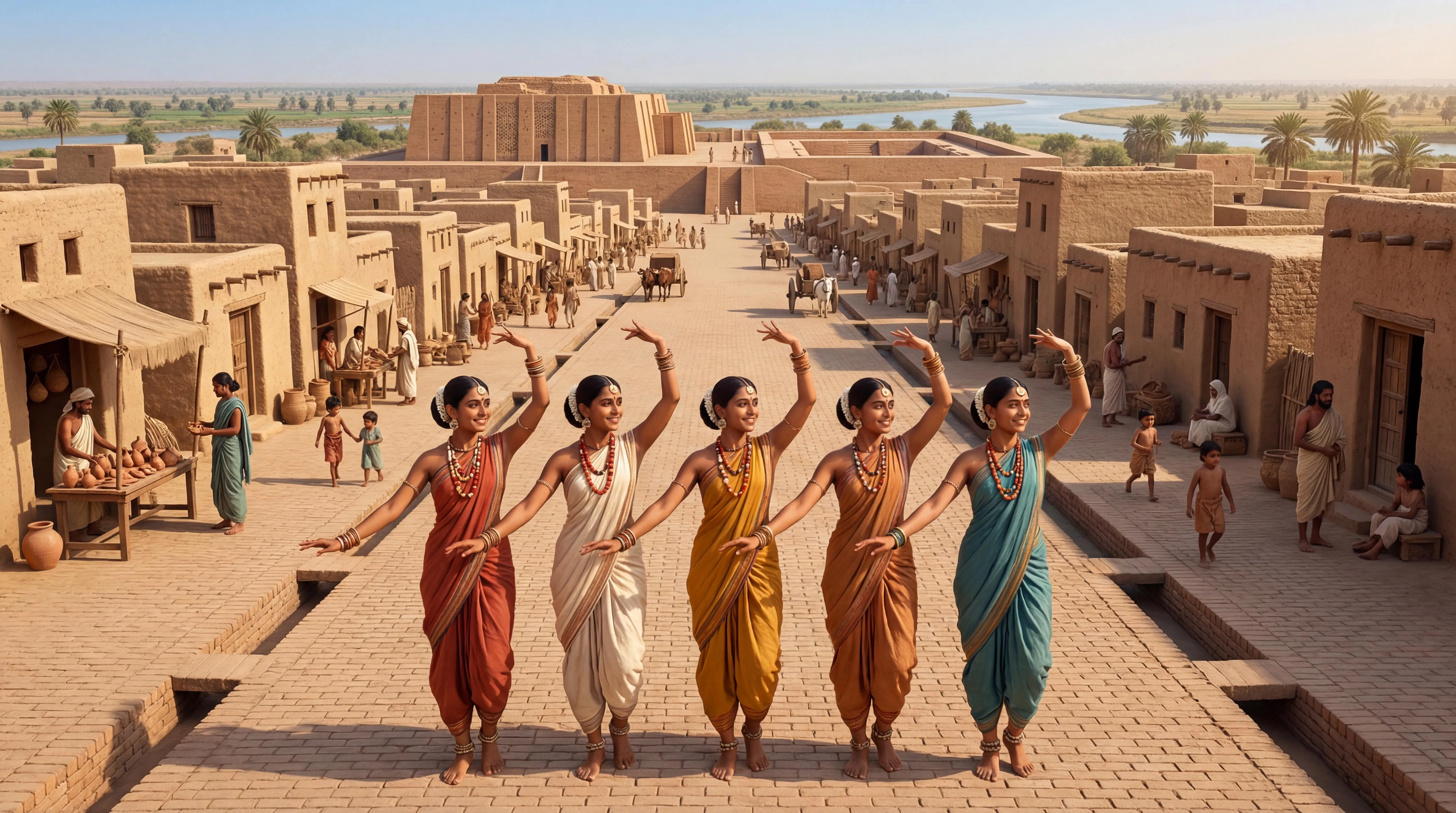
Photorealistic scene of a bustling Indus Valley Civilization city like Mohenjo-Daro or Harappa at its peak around 2600 BCE, vibrant daytime under clear blue sky with Indus River in distant background, fertile plains and palm trees. Foreground: Five beautiful young women standing in a perfect straight line on a wide brick-paved street (10m broad, straight north-south axis), fully visible from head to toe, poised and ready to dance with joyful expressions, arms gracefully raised in synchronized pose. They wear authentic lightweight cotton draped garments (long shawls over one shoulder, ankle-length skirts/dhotis) in earthy terracotta red, off-white, ochre yellow, and subtle blue-green dyes; adorned with large colorful beaded necklaces (carnelian, agate, shell beads), bangles, anklets, nose rings, and hair buns with shell combs – no modern elements, historically accurate Dravidian features, smooth brown skin, long dark hair. Background: Thriving non-ruined city with precise orthogonal grid street layout (right angles, rounded corners for carts), uniform multi-story baked-brick houses (standard bricks 28x14x7cm, 1-2 stories high, flat roofs accessed by external stairs, deep central courtyards for light/ventilation, minimal street-facing windows, wooden door frames), elevated Citadel mound with massive granary platform (50x50m ventilated shafts) and nearby Great Bath (12x7m rectangular pool, 2.4m deep, bitumen waterproofed, flanked by changing rooms and stepped access ramps), market stalls with clay seals, advanced covered brick drains (1m wide with inspection holes) lining every street, people in period clothing (men in simple kilts/dhotis carrying pottery or baskets, women in shawls with jewelry trading goods), ox-carts, children playing, overall lively urban atmosphere. Highly detailed, authentic archaeology-based reconstruction, warm sunlight, high resolution, no anachronisms, cinematic composition focusing on the women line against the cityscape.